


| Quantity: | |
|---|---|


 L-shaped shielding
L-Block Tabletop PET Shield
External radiation protection (primary function)
By utilizing the attenuation effect of lead plates/lead glass on gamma and X-rays, a barrier is established between operators and radioactive drugs (such as ¹⁸ F, ⁹⁹ᵐ Tc, ¹³ ¹ I, ¹² ⁵ I, etc.) to minimize the dose received by personnel (ALARA principle). The common configuration in the environmental impact assessment report is an L-shaped lead protective screen (such as 10mm Pb equivalent) used for injection operations in animal administration areas, which can effectively reduce the radiation dose to workers during the injection process.
Anti lateral scattered radiation
The two sides of the L-shaped screen (front and side) can simultaneously block both direct and scattered/leaked radiation from the front and sides of the radiation source, which is its advantage over single-sided straight panel screens. Multiple L-shaped screens can also be combined into a surround style workbench, which can merge multiple L-shaped lead screens to form a workbench, allowing most operators to work simultaneously.
Maintain observation field of view
The screen is embedded with lead glass windows, which "facilitate observation while effectively reducing the radiation dose received by radioactive workers during PET quality control operations or other radioactive operations", both protecting and not affecting fine operations (packaging, suction, injection).
Partial 'closure' operation
By using tools such as long handled pliers and tweezers, operators can perform close range operations on their hands and torso behind the screen, reducing hand doses; It is also used for "closed shielding operation" in fume hoods in chemical laboratories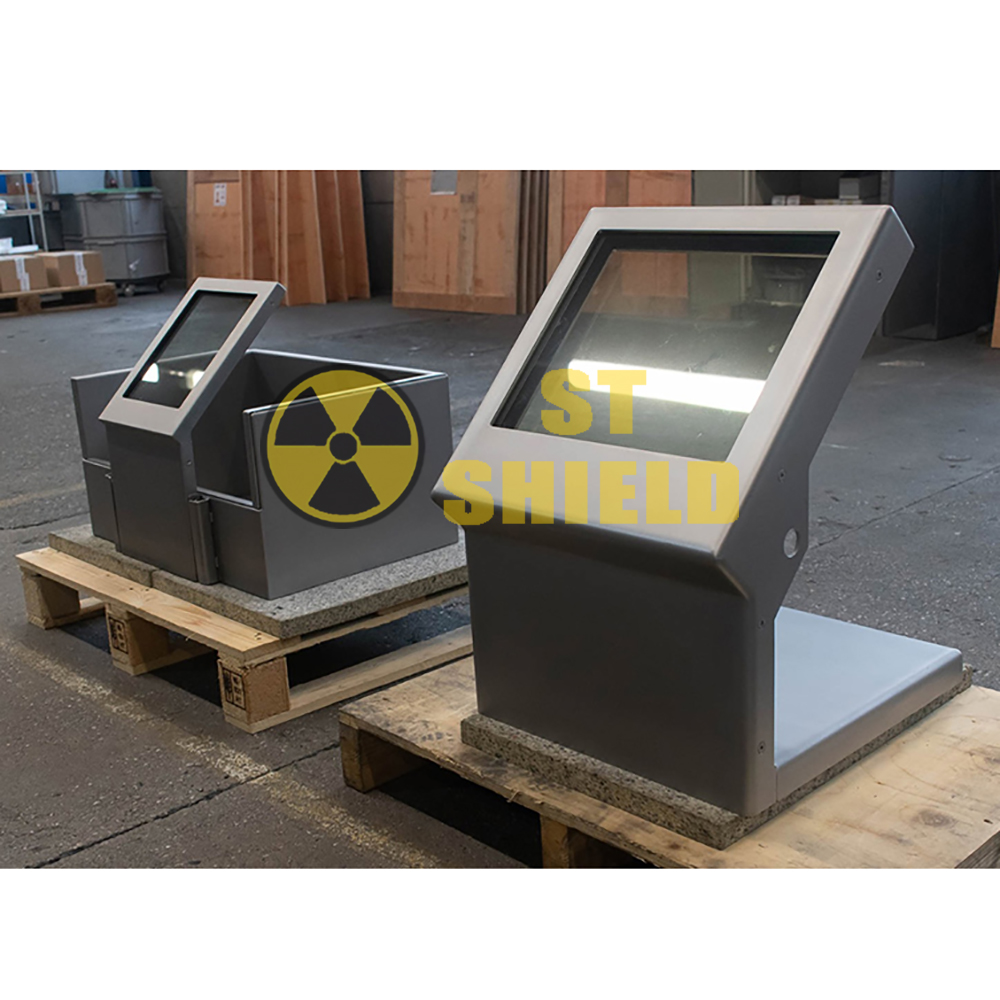
Lead Shielding:
- Front: 1.5" thick (3.8 cm)
- Base: 1" thick (2.5 cm)
- Calibrator Shield: 1” thick (2.5 cm)
Lead Glass Window:
- Dimensions: 8" w x 8" h x 4" thick (20.3 x 20.3 x 10.2 cm)
- Density: 5.2 g/cm3
Finish: Stainless Steel
Nuclear medicine discipline: radioactive drug packaging, injection, quality control (PET drugs are particularly common)
Drug/chemical laboratory: local shielding for high activity operations in fume hoods
Radiation animal experiments: protection during administration and observation
Bedside operations such as particle implantation and intervention
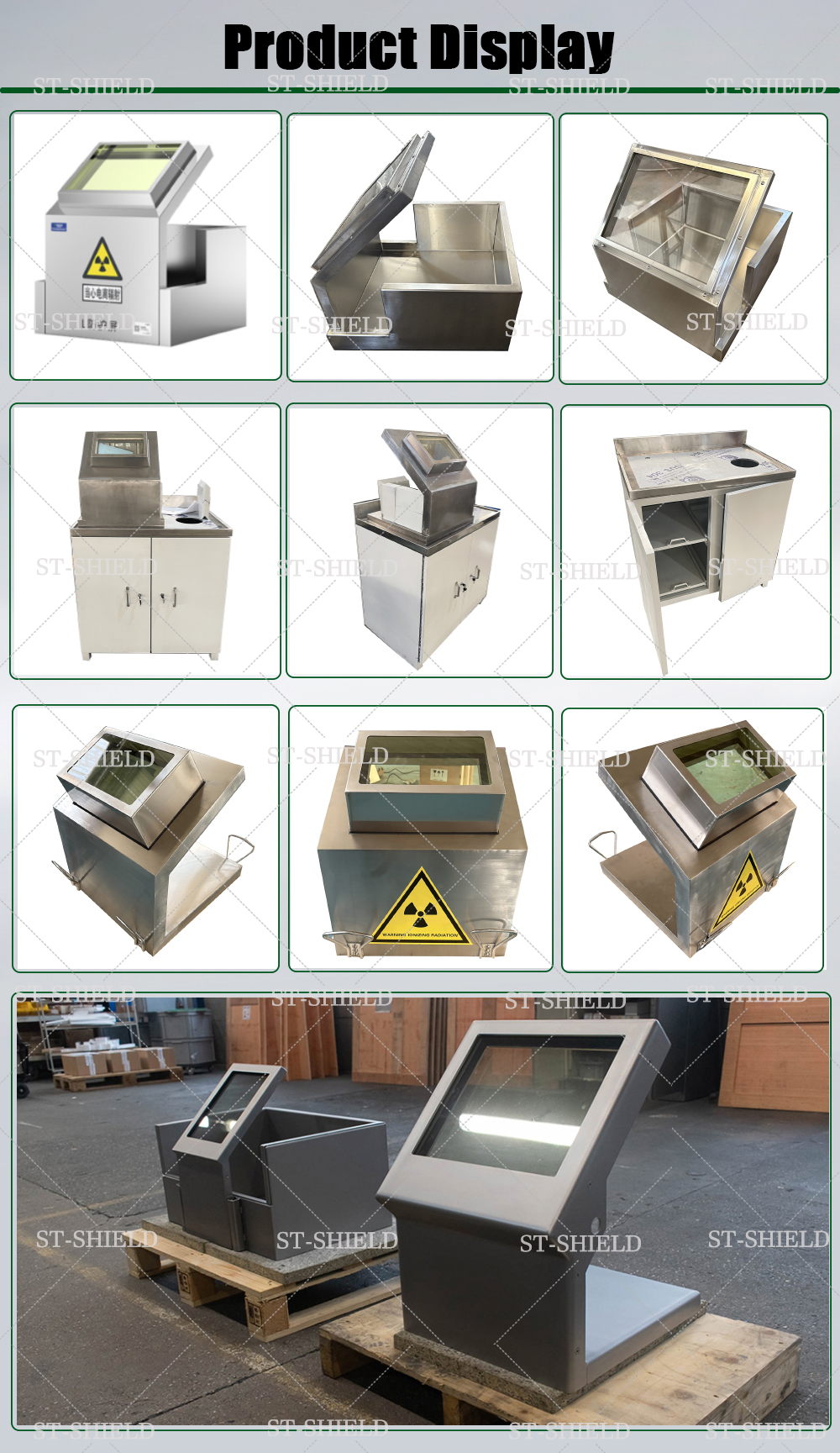
1. Excessive personnel radiation dose and high pressure on occupational health management
Pain points: The PET/nuclear medicine packaging injection process has high activity (¹⁸ F, ⁹⁹ᵐ Tc hundred mCi level), and the annual dose to the operator's hands, chest, and abdomen approaches or exceeds the occupational limit; Environmental impact assessment and health commission inspections are becoming increasingly strict, and exceeding the dosage limit is a "hard problem" for the department.
Solution: L-shaped double-sided (front+side) lead screen is used to construct a physical barrier, effectively reducing the radiation dose to workers during the injection process; The personal dosimeter data can be verified, helping the department smoothly pass the environmental impact assessment acceptance and radiation protection testing.
2. Protection and visual operation cannot be achieved at the same time
Pain points: Completely enclosed glove boxes are inconvenient to operate, inefficient, and result in concentrated hand doses; Pure lead plates block the line of sight, and fine packaging, suction, and injection are prone to errors (dosage error=medical accident risk).
Solution: The screen is embedded with a lead glass window, which "facilitates observation while effectively reducing the radiation dose received by radioactive workers", achieving a balance between "clear visibility, easy reach, and blocked radiation".
3. Side scattered radiation cannot be prevented, and a single-sided screen is virtually useless
Pain point: The straight/single-sided screen can only block the front; After administration, patients become mobile radiation sources, peripheral devices, and tabletops that scatter, causing "leakage" from the side wings to the operators. Dose monitoring often reveals that the side dose is higher than the front dose.
Solution: The L-shaped bending structure shields both the front and side surfaces, cutting off the scattering path; Multiple screens can be combined to form a surround workbench, allowing most operators to work simultaneously without interference.
4. Different nuclides/activities result in insufficient or wasteful protection for "measuring everything with one ruler"
Pain point: Using thick lead for low-energy isotopes wastes money and is deadly; High energy nuclides (PET 511keV, ¹³ ¹ I 364keV) cannot be protected with a thin screen. I don't know whether to choose 2mmPb or 10mmPb when purchasing.
Solution: Provide customized graded lead equivalent -2-2.5mmPb for low activity fume hood operation, 5-10mmPb for high activity injection position, tailored according to nuclide energy and activity, ensuring compliance with protection standards and cost control.
5. The equipment is bulky, the layout is fixed, and moving it once will "mobilize the troops"
Pain points: Long construction period for fixed lead rooms and frequent shutdowns for departmental renovations; The heavy-duty lead screen has no wheels, and when adjusting the injection position and adding bedside protection (particle implantation, intervention), it needs to be lifted by people, which poses a risk of crushing and waist injury.
Solution: The mobile design is equipped with universal wheels and can be fixed, which can be combined with an injection cart to combine an L-shaped lead ray protection screen with a 304 stainless steel injection cart. It is construction free, ready to use, and can be flexibly arranged according to the task flow.


