

Views: 0 Author: Site Editor Publish Time: 2026-05-13 Origin: Site


Radiation protection remains a critical priority in modern medical and industrial environments. Facilities must constantly balance procedural efficiency against strict safety protocols. Historically, static room designs forced staff to work within rigid structural boundaries. Today, dynamic workflows require adaptable, point-of-care radiation protection. A mobile Lead Shielding Screen effectively mitigates secondary scatter exposure. It protects healthcare workers, technicians, and patients when permanent walls cannot.
This article provides a structured framework for evaluating, selecting, and implementing the correct shielding solutions. You will learn how to match equipment to specific imaging modalities. We will guide facility managers, procurement officers, and safety compliance teams through essential safety standards and operational impacts.
Primary Function: Mobile lead shielding screens block scatter radiation in environments where fixed structural shielding is impractical or insufficient.
Core Specification: Protection levels are dictated by Lead Equivalence (Pb eq), typically ranging from 0.5mm to 2.0mm, which must align with the specific imaging modality's energy output.
Operational Impact: Caster quality, center of gravity, and lead glass window size directly impact staff ergonomics, workflow efficiency, and clinical visibility.
Compliance Baseline: Selection must align with ALARA (As Low As Reasonably Achievable) principles and local regulatory shielding calculations.
Radiation sources vary widely across different professional settings. You must understand your specific environment to deploy effective protection. Various departments face unique spatial and clinical challenges. They rely on portable barriers to maintain safety without disrupting essential tasks.
Modern operating rooms utilize continuous imaging. Fluoroscopy and C-arm machines guide surgeons during complex procedures. However, these tools generate significant secondary scatter radiation. A Lead Shielding Screen protects non-scrubbed personnel. Anesthesiologists and circulating nurses often work near the radiation source. They cannot always wear heavy lead aprons. Placing a portable barrier between the patient table and the anesthesia workstation dramatically reduces their exposure dose during electrophysiology and vascular procedures.
Emergency departments require rapid responses. Staff frequently conduct mobile X-rays directly in trauma bays. Moving critical patients to a dedicated imaging room takes too much time. Open-ward settings present a massive challenge for radiation safety. Adjacent patients, nurses, and family members remain exposed. A rolling screen provides temporary, immediate shielding. You can quickly position it to block scatter trajectories, ensuring safety during high-stress emergency diagnostics.
Smaller clinics often operate in retrofitted office spaces. These buildings usually lack lead-lined walls. Building permanent structural barriers proves structurally difficult. Dental practices use panoramic imaging systems. Veterinary clinics image animals ranging from small pets to large livestock. In these diverse environments, a mobile shield offers versatile scatter protection. It allows staff to step behind a safe zone instantly. This approach safely accommodates multi-use rooms without heavy construction.
Radiation extends far beyond healthcare. Industrial non-destructive testing utilizes high-energy X-rays and gamma rays. Technicians inspect pipeline welds, aerospace components, and concrete structures. These environments produce intense radiation levels. Technicians require heavy-duty barriers. A high-equivalence portable shield protects operators during active material testing. They can move the shield across large warehouse floors, maintaining safety near varying inspection sites.
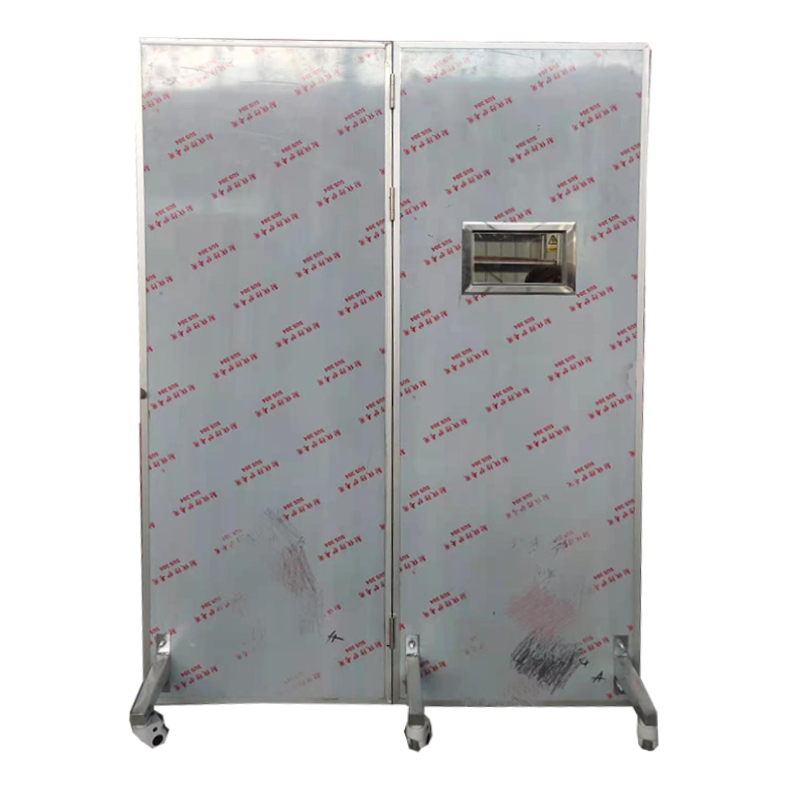
Choosing the right barrier involves analyzing your operational footprint. Facilities must decide between permanent architecture and portable solutions. Often, the best radiation safety programs combine several approaches. Understanding when to use each category ensures maximum protection and usability.
Portable screens shine in dynamic environments. They are ideal for retrofitted rooms where installing wall lead proves impossible. Facilities sharing imaging equipment between multiple rooms benefit greatly from mobile units. You can simply roll the shield to wherever the C-arm goes. Furthermore, they allow facility managers to prioritize layout flexibility. If a department relocates or redesigns its floor plan, mobile barriers move seamlessly. They require zero architectural modifications.
Some situations absolutely demand permanent installations. You must rely on fixed shielding for primary beam protection. A primary X-ray beam carries vastly more energy than scatter radiation. Walls must absorb this direct impact. High-volume, static-position interventional setups also require fixed solutions. In cramped cath labs, floor space remains critically restricted. Ceiling-suspended shields save floor space. They hang directly over the patient, providing localized protection without blocking walking paths.
The most advanced safety protocols utilize hybrid methods. No single barrier stops all radiation trajectories. You can use a mobile Lead Shielding Screen as a supplementary tool. It augments ceiling-suspended acrylic shields and under-table lead drapes. For example, the suspended shield protects the surgeon's upper body. The under-table drape blocks scatter to their legs. A mobile screen placed a few feet away protects the monitoring technician. This layered strategy guarantees comprehensive coverage.
Shielding Type | Primary Use Case | Flexibility | Floor Space Requirement |
|---|---|---|---|
Mobile Screen | Scatter protection, shared rooms, ER, OR | Very High | Moderate (requires rolling clearance) |
Fixed Wall Shield | Primary beam blocking, dedicated X-ray rooms | None | Minimal (integrated into architecture) |
Suspended Shield | Targeted upper-body interventional protection | Low/Moderate (articulating arm) | Zero (ceiling-mounted) |
You cannot purchase radiation protection blindly. Evaluating technical specifications ensures the equipment meets precise clinical demands. Procurement teams must scrutinize attenuation levels, visibility parameters, and physical maneuverability.
Lead equivalence determines how effectively a barrier stops radiation. It measures the material's stopping power compared to pure lead. You must match this rating to your equipment's energy output.
0.5mm Pb: This standard works beautifully for low-energy environments. General X-ray rooms, dental offices, and standard veterinary clinics rely on 0.5mm barriers. They provide excellent scatter attenuation without extreme weight.
1.0mm - 2.0mm+ Pb: High-energy modalities demand thicker protection. CT scanners, nuclear medicine wards, and specialized industrial applications generate intense radiation. These environments require 1.0mm to 2.0mm equivalence to keep exposure within acceptable limits.
A solid lead wall offers perfect protection but terrible utility. Staff must monitor patients and equipment during procedures. Viewing windows bridge this gap. You must evaluate the window material carefully.
Lead-acrylic offers distinct advantages. It is lighter and highly shatter-resistant. It suits busy emergency rooms where impacts occur frequently. Conversely, lead-glass provides higher light transmission. It looks clearer. It also achieves higher attenuation density in a thinner profile. However, it shatters more easily. Sizing the window correctly matters just as much. Large windows prevent clinical blind spots. Yet, oversized glass panels reduce structural integrity and increase tipping risks.
If a screen is too hard to move, staff will not use it. Weight distribution plays a massive role in daily operations. Heavy lead panels require a very low center of gravity. Top-heavy designs create severe tipping hazards, threatening patient safety. Caster design dictates maneuverability. Evaluate units featuring hospital-grade, anti-static casters. They must bear high dynamic loads. Lockable mechanisms keep the screen firmly planted once positioned.
Infection control dictates equipment design in healthcare. A Lead Shielding Screen must withstand rigorous cleaning. Stainless steel frames offer unmatched durability and rust resistance. Powder-coated aluminum or steel frames provide a lighter alternative. Pay close attention to seam configurations. Fluids and bacteria gather in crevices. Smooth, welded seams ensure compatibility with harsh, hospital-grade disinfectants. You must clean the unit thoroughly without degrading the radiation core.
Best Practices for Equipment Evaluation
Test caster rolling resistance on your actual hospital flooring before bulk purchasing.
Verify the exact height of the viewing window matches the average eye level of your clinical staff.
Ensure the frame base allows equipment pedals and cables to pass underneath safely.
Radiation safety relies heavily on strict regulations. Buying an uncertified shield invites legal and physical risks. Compliance verification protects your staff and your organization's operational license.
Every product must meet local health department requirements. In the United States, FDA guidelines govern medical devices. Regional equivalents apply internationally. You must verify compliance with IEC (International Electrotechnical Commission) standards for medical electrical equipment environments. These regulations ensure the device performs predictably under clinical stress. Furthermore, selection must align strictly with ALARA principles. The goal is always to keep radiation exposure "As Low As Reasonably Achievable."
Never guess your attenuation requirements. You need a certified Medical Physicist. They generate a detailed shielding calculation report for your specific room and modality. They measure the scatter trajectories, workload, and occupancy factors. The necessity of matching the screen's specifications to this report cannot be overstated. A physicist guarantees you buy enough protection without over-specifying and adding unnecessary weight.
Manufacturing flaws compromise safety. A screen might claim 1.0mm equivalence, but poor construction ruins its effectiveness. You must verify manufacturer testing data. Request documentation proving uniform lead distribution. Poorly poured lead creates "hot spots." Radiation leaks through these microscopic gaps. Pay special attention to the seams where the glass meets the frame. High-quality manufacturers provide scan results demonstrating zero leakage at these crucial junctions.
Successfully purchasing a screen is only half the battle. Bringing it into your facility presents unique physical and logistical challenges. Anticipating these hurdles guarantees a smooth deployment.
Lead is exceptionally heavy. Planning for delivery requires attention to detail. Standard mobile screens often weigh between 100 and 300 pounds. Industrial variants weigh even more. They arrive on large wooden pallets. Your receiving dock needs a forklift or a heavy-duty pallet jack. Navigating a 250-pound crate through narrow hospital corridors requires specialized handling. Some units ship disassembled to prevent glass breakage. Ensure your clinical engineering team has the tools and time for proper assembly upon arrival.
Heavy screens interact aggressively with flooring. They can quickly damage soft vinyl flooring or sink into plush carpets. Trying to push a heavy screen over uneven transition strips strains staff backs. The caster size must perfectly match the facility's flooring type. Larger wheels handle elevator gaps and floor transitions much better than small, rigid wheels. Evaluate your travel paths before deployment.
Equipment only works if staff use it correctly. There is a massive risk of inadequate protection if teams lack training. Staff must understand proper spatial positioning relative to the scatter source. Placing the screen too far from the patient diminishes the protective shadow. Angling it incorrectly exposes the user's side. Run practical drills. Show technicians exactly where to stand. Continuous education ensures the equipment achieves its intended safety goals.
Common Implementation Mistakes
Assuming standard delivery drivers will bring heavy lead screens inside the clinical suite.
Failing to measure the width of older, narrow hospital doorways before ordering wide screens.
Using abrasive scrub pads on lead-acrylic windows, causing irreversible clouding.
Organizing your procurement process prevents costly errors. Follow a disciplined, step-by-step approach to identify the perfect shielding solution for your department.
Step 1: Define the Modality. Determine the maximum kilovoltage peak (kVp) of your imaging equipment. This technical metric establishes the baseline energy. Use this data to calculate the required Pb equivalence.
Step 2: Measure the Environment. Grab a tape measure. Assess your doorway widths, ceiling heights, and available storage space. These physical dimensions dictate the maximum allowable size of the screen. You cannot use a shield that does not fit in the equipment closet.
Step 3: Review Warranties and Certifications. Build a shortlist of reputable manufacturers. Demand transparent attenuation testing certificates. Review the fine print on warranties. Focus heavily on caster mechanisms and glass housing, as these parts fail most often.
Step 4: Request a Trial or Consultation. Engage directly with vendors. Ask for customized quotes and bulk-order timelines. Request facility-specific configuration advice. A good vendor will review your floor plans and recommend the safest geometric setups.
Investing in a mobile lead shielding screen demands careful consideration. You must balance verifiable radiation attenuation against structural safety and daily operational usability. A poorly designed shield frustrates staff and slows down clinical workflows. We know the cheapest option often introduces hidden complications. Flimsy casters break, and poor frame designs fail infection control audits.
By following the evaluation criteria outlined above, you ensure your team remains safe and compliant. Prioritize ergonomics, verify medical physicist calculations, and prepare for heavy logistics. Do not leave radiation safety to chance.
Take action today. Consult your radiation safety officer. Review your current facility compliance reports. Finally, contact a specialized vendor to discuss your customized shielding requirements and schedule a site assessment.
A: Standard equivalence typically ranges from 0.5mm to 2.0mm Pb. Low-energy applications like dental and general X-ray usually require 0.5mm. High-energy environments like CT or industrial testing need 1.0mm to 2.0mm. The exact requirement strictly depends on your specific radiation source and a certified medical physicist's assessment.
A: Yes. Many manufacturers build custom panels. They offer tailored widths, adjustable heights, and specific window sizes. Customization helps facilities fit barriers into tight corners, navigate narrow retrofitted doorways, and match the screen exactly to unique clinical workflow constraints.
A: Wipe down the surfaces using non-abrasive, hospital-approved disinfectants. You must avoid harsh solvents or alcohol-heavy cleaners on lead-acrylic windows, as they cause clouding. Maintenance requires regular caster lubrication and routine visual inspections of all structural seams.
A: The internal lead core does not spontaneously degrade or expire. However, the physical casing, casters, and glass or acrylic windows suffer significant wear and tear from daily clinical use. You must conduct routine structural inspections to ensure the frame remains intact and safe.


