In any environment where X-rays are used—whether it’s a hospital radiology department, a dental clinic, a veterinary practice, or a mobile imaging unit—radiation safety is not just a checkbox. It’s a daily operational requirement that protects people, supports compliance, and builds long-term trust with staff and patients. A lead apron is one of the most recognized tools in radiation protection, but it’s also one of the most misunderstood. Some teams overuse it in low-risk situations and end up with fatigue, poor fit, and inconsistent wear. Other teams underuse it where scatter radiation is common, putting staff at unnecessary risk over time. The real question isn’t “Do we have lead aprons?”—it’s “Who needs a lead apron, when, and why?” In this guide, we’ll break down the roles, settings, and decision factors that determine lead apron use, so you can build a practical, safety-first approach that fits your workflows without slowing down care or productivity.
A lead apron is personal protective equipment designed to reduce exposure to scatter radiation—the secondary radiation that bounces off a patient, table, or nearby surfaces during X-ray-based procedures. Most real-world occupational exposure in imaging comes from scatter, not from standing in the primary beam.
What a lead apron does well:
Reduces scatter radiation reaching radiosensitive organs (especially torso).
Supports safer work near fluoroscopy and mobile radiography.
Helps facilities meet safety policies and local regulations when properly used.
What a lead apron is not meant to do:
It is not designed to protect someone who is directly in the primary X-ray beam.
It is not a replacement for room shielding, protective barriers, distance, or procedural controls.
It does not eliminate exposure—it reduces it.
You’ll often see “lead equivalence” (like 0.25, 0.35, or 0.5 mm Pb) used to describe how protective an apron is under specified conditions. Choosing the right level is about balancing protection, comfort, and the typical energy range of your procedures.
A lead apron becomes necessary when a person is likely to be in a location where scatter radiation is present at meaningful levels, especially when exposure is frequent or prolonged. Common scenarios include:
Fluoroscopy and interventional procedures (high scatter potential)
Mobile X-ray (less structural shielding, variable positioning)
Operating rooms using C-arms (staff close to the source and patient)
Veterinary imaging (staff often near the animal during positioning)
Dental imaging in some specific cases (depending on technique and policy)
Industrial radiography/NDT environments (requires specialized safety controls)
That said, not everyone in a building with an X-ray room needs an apron. The “right answer” depends on time, distance, shielding, and the procedure type.
Technologists performing fluoroscopy, mobile radiography, or assisting with difficult positioning are among the most consistent apron users. If you’re in the room during exposure—especially near the patient—aprons (plus thyroid collars in many workflows) are standard.
Interventional cardiology, vascular, pain management, orthopedics, GI procedures, and many OR workflows involve extended fluoroscopy time. Physicians and surgeons working close to the field typically need:
A properly fitted lead apron (often vest-skirt for long cases)
Thyroid protection
Additional options like lead glasses depending on practice needs
Nurses and anesthesia teams may not “operate the X-ray,” but they can spend substantial time near the patient during imaging. If staff remain in the room during fluoroscopy or repeated imaging, aprons are commonly needed.
In many dental workflows, staff step behind a barrier or maintain distance during exposure, reducing the need for routine apron use by staff. However, certain setups, room constraints, or special procedures may change that. Patient shielding policies can also vary by region and facility.
Veterinary imaging often involves positioning animals that can’t follow instructions, increasing staff proximity. In these settings, it’s common for staff to use lead aprons, thyroid collars, and sometimes gloves—paired with clear positioning protocols to minimize hands-on exposure.
If a trainee or observer is in the room during exposure and cannot remain behind a protective barrier at a safe distance, a lead apron is generally recommended.
Patients typically benefit more from correct technique, collimation, and dose optimization than from routine aprons in all situations. Policies differ widely, but patient shielding may still be used in specific cases:
When shielding does not interfere with image quality
When the protected area is outside the imaging field but could receive scatter
When local policy requires it
For companions/caregivers who must remain close to a patient during exposure (for example, pediatric support), a lead apron is commonly used.
Pregnancy introduces additional policy considerations. A facility’s radiation safety officer or safety protocol typically defines requirements. In occupational settings, pregnant staff may use specialized approaches (including additional monitoring and protective garments) depending on duties and exposure potential.

Role / Setting | Typical exposure source | When a lead apron is commonly needed | Helpful add-ons |
Fluoroscopy technologist | High scatter near patient | Most cases in-room during exposure | Thyroid collar; sometimes lead glasses |
Interventional physician | Prolonged scatter | Routine for procedures | Vest-skirt; thyroid; glasses |
OR nurse / anesthesia | Scatter during C-arm use | When staying in-room near field | Thyroid collar depending on workflow |
Mobile X-ray technologist | Variable scatter in wards/ICU | When exposure occurs nearby | Lightweight apron options |
Veterinary staff | Close positioning | Often needed due to proximity | Thyroid collar; gloves (case-dependent) |
Dental staff | Often behind barrier | Usually not needed if behind shielding | Follow facility policy |
Patient companion | Near patient during exposure | When must stay close in-room | Apron; positioning guidance |
Students/observers | Variable | If in-room without barrier distance | Apron and clear boundaries |
Different lead equivalence levels are used depending on procedure type, distance, and expected scatter. Heavier protection can increase fatigue if worn for long cases—so selection should be realistic.
Lead equivalence (typical labeling) | Where it’s commonly used | Practical note |
0.25 mm Pb | Lower scatter tasks, short wear | Lighter, more comfortable |
0.35 mm Pb | General mixed-use environments | Balanced protection/weight |
0.5 mm Pb | Higher scatter or long fluoroscopy | Heavier; consider vest-skirt |
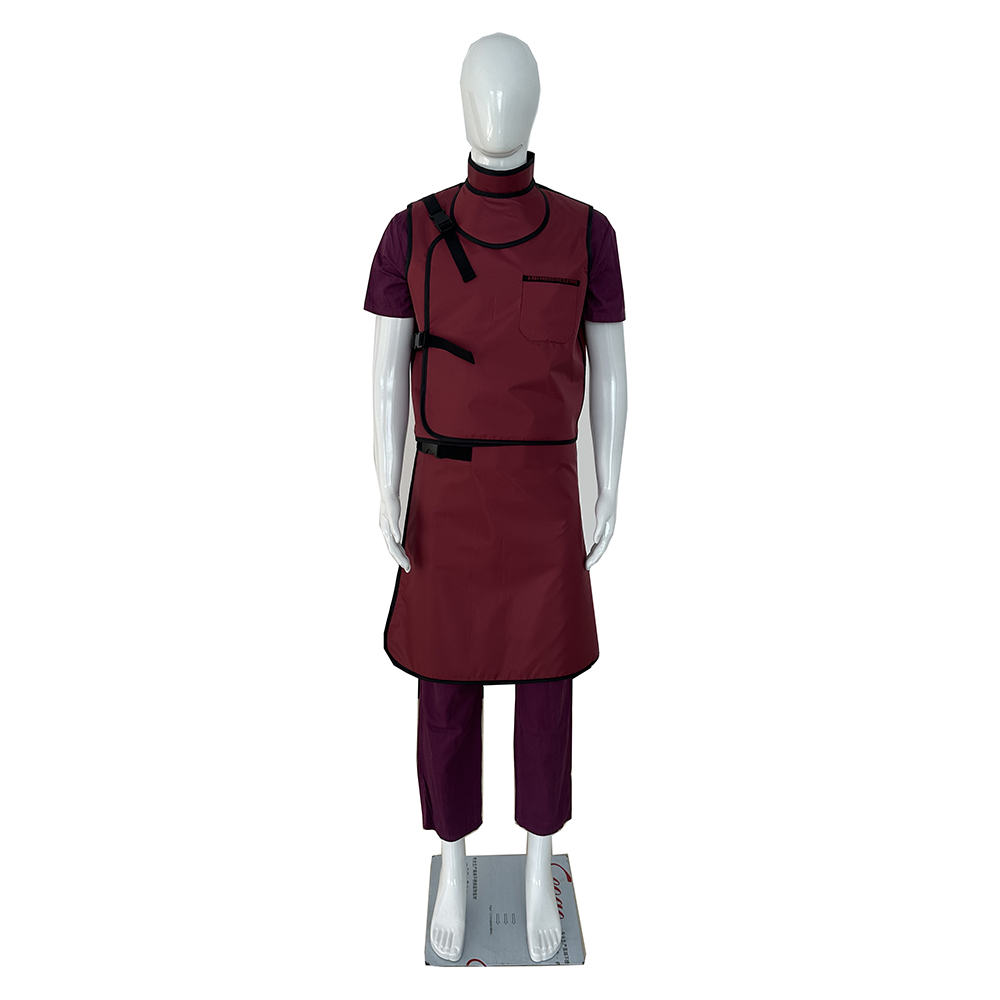
Common designs include:
Front protection aprons (simple, quick on/off)
Wraparound aprons (better all-around coverage for movement)
Vest and skirt (weight distributed; preferred for long procedures)
A poorly fitted apron creates gaps, rides up, strains shoulders, and discourages compliance. Consider:
Correct length and torso coverage
Shoulder design and weight distribution
Mobility needs (OR workflows vs. static imaging rooms)
Depending on your risk profile and procedures, you may consider:
Thyroid collars (common in fluoroscopy/OR)
Lead glasses (for staff close to field, frequent fluoroscopy)
Gloves (only when necessary; protocols should aim to keep hands out of beam)
Even the best apron can lose effectiveness if it’s cracked, folded improperly, or never inspected. A practical care program often includes:
Hanging storage (avoid sharp folding)
Routine visual checks for damage
Periodic imaging-based inspection (per facility policy)
Cleaning guidance matched to apron material
Clear labeling and inventory tracking so aprons aren’t “mystery gear” with unknown history
When a facility treats aprons like durable safety equipment—not disposable accessories—compliance improves and long-term costs usually decrease.
A lead apron is a practical, proven layer of protection—but only when it’s used by the right people in the right situations. In day-to-day imaging, the groups most likely to need lead aprons are those who remain in the room during exposure and work close to the patient, especially in fluoroscopy, interventional suites, operating rooms, mobile radiography, and many veterinary settings. At the same time, a smart program avoids “one-size-fits-all” decisions. It considers procedure type, exposure frequency, room shielding, staff positioning, comfort, and fit—because protective gear that’s uncomfortable or poorly maintained quickly becomes gear that’s not worn. From our perspective as a manufacturing partner, the goal is straightforward: help teams stay safe without slowing down the work. If you’re reviewing your current radiation protection setup, planning new purchasing standards, or trying to improve staff compliance through better fit and clearer selection, we’re ready to support you with practical guidance and reliable options. To learn more about lead apron solutions and application-based selection, you can reach out to Liaocheng ST Technologies Co., Ltd. and discuss what fits your environment best.
Q: Who needs a lead apron in a fluoroscopy room?
A: Anyone staying in-room during fluoroscopy near the patient typically needs a lead apron, since scatter radiation is common.
Q: Do nurses and anesthesia staff need lead aprons?
A: If they remain in the room during X-ray exposure—especially near the field—a lead apron is commonly recommended by facility policy.
Q: Are lead aprons required for mobile X-ray?
A: Mobile X-ray often involves variable positioning and limited shielding, so staff near exposure areas may need a lead apron.
Q: How do I choose the right lead apron for my team?
A: Start with procedure type, typical exposure time, and comfort needs, then select lead equivalence, fit, and design accordingly.