In radiation protection environments, flexibility and safety often need to coexist. Hospitals, diagnostic centers, laboratories, and industrial inspection facilities increasingly require shielding solutions that can adapt to changing layouts, temporary work zones, or mobile equipment. This naturally raises a common question from engineers and procurement teams: Is a lead screen portable?
From our experience supplying radiation shielding solutions for medical and industrial projects, the short answer is yes—lead screens can be portable, but portability depends heavily on design, structure, and intended application. In this article, we explain what makes a lead screen portable, where mobility is practical, and how portable lead screens are commonly used across industries.
A lead screen is a radiation shielding barrier constructed using lead sheet or lead glass, typically integrated into a steel, aluminum, or composite frame. Its primary function is to block or attenuate ionizing radiation such as X-rays or gamma rays, protecting personnel and sensitive equipment.
Lead screens are widely used in:
Medical imaging rooms
Dental clinics
Industrial radiography sites
Research laboratories
Nuclear medicine departments
Depending on the design, lead screens may be fixed installations or movable units designed for flexible use.
In radiation protection, the term “portable” is often misunderstood. Unlike consumer products, portability in shielding equipment does not imply light weight or effortless carrying. Lead is inherently dense, and this density is precisely what makes it effective at attenuating ionizing radiation. As a result, no lead-based shielding product can be truly lightweight.
Instead, portability in radiation shielding refers to controlled mobility—the ability to move, reposition, or relocate a lead screen safely and efficiently without dismantling the structure or compromising shielding integrity. A portable lead screen is designed to be moved intentionally, under control, and within a defined operating environment.
A typical portable lead screen includes several structural and functional features:
Integrated wheels or casters that allow smooth movement across facility floors
Modular or segmented construction to reduce individual component weight
Balanced frame geometry that distributes mass evenly
Handles or push bars to guide controlled manual movement
These features allow technical staff to reposition shielding in response to workflow changes, equipment relocation, or temporary radiation zones—without requiring permanent installation or structural modification.
Yes—but only through intentional engineering and design optimization.
Lead has a density of approximately 11.34 g/cm³, which makes it one of the most effective and widely used materials for radiation shielding. This density enables thinner shielding layers compared to many alternative materials. However, it also means that even relatively small panels can become heavy once thickness increases to meet radiation safety requirements.
Weight increases rapidly as:
Lead thickness increases
Screen surface area expands
Additional structural reinforcement is added
Without proper design, this weight would make movement unsafe or impractical.
Manufacturers achieve portability not by reducing shielding performance, but by managing weight intelligently. Common engineering strategies include:
Optimizing lead thickness to match the actual radiation energy and exposure level, avoiding unnecessary over-shielding
Reinforced frame systems that distribute weight evenly and prevent bending or deformation during movement
Heavy-duty medical-grade casters designed to support high loads while maintaining smooth rolling resistance
Controlled screen dimensions, ensuring that each unit remains maneuverable within corridors and rooms
The objective is not to eliminate mass, but to ensure that mass can be moved safely, predictably, and repeatedly within operational environments.
Not all lead screens offer the same level of mobility. Their classification depends on how frequently they are moved and how much flexibility is required.
Lead Screen Type | Mobility Level | Typical Applications |
Fixed lead screen | None | Permanent imaging or shielding rooms |
Semi-mobile lead screen | Limited | Occasional repositioning within a room |
Fully portable lead screen | High | Temporary or shared work zones |
Modular lead screen | Medium–high | Reconfigurable or expandable layouts |
Portable and modular lead screens are especially common in facilities where room layouts change frequently, such as multi-purpose imaging rooms, industrial testing areas, or research labs. In contrast, fixed screens remain appropriate where radiation sources and workflows are stable and permanent.
Portability is not achieved through a single component, but through a combination of structural, mechanical, and ergonomic design choices.
The frame is the backbone of a portable lead screen. High-quality units use rigid steel or aluminum frames designed to resist torsion and flexing during movement. Structural rigidity is essential to:
Maintain shielding alignment
Prevent panel deformation
Ensure long-term durability
A weak frame can compromise both safety and lifespan, regardless of lead thickness.
Mobility depends heavily on the wheel system. Professional portable lead screens typically use:
Lockable casters to prevent unintended movement during use
Anti-static medical-grade wheels suitable for clean or sensitive environments
Load-rated bearings designed for continuous high-weight operation
These components allow the screen to move smoothly while remaining stable once positioned.
Portability is closely tied to size. Smaller or segmented screens are easier to maneuver, especially in confined spaces. In many facilities, multiple portable screens are used together rather than relying on one oversized barrier. This approach offers:
Easier handling
Greater layout flexibility
Reduced movement risk
Portability must never compromise stability. Well-designed portable lead screens maintain a low center of gravity, reducing the risk of tipping during movement or operation. Safety-focused designs also consider:
Base width relative to screen height
Weight distribution across the frame
Controlled movement speed
These factors ensure that portability enhances usability without introducing new hazards.
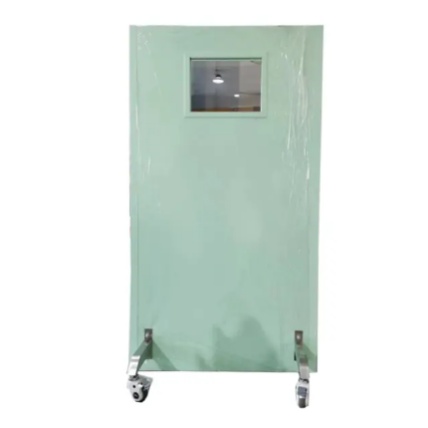
In hospitals and clinics, portable lead screens are used to:
Shield staff during mobile X-ray procedures
Create temporary radiation barriers
Adapt to shared imaging rooms
Portable lead screens are essential where:
Inspection locations change frequently
Permanent shielding is impractical
On-site radiation safety zones are required
Labs benefit from portable lead screens when:
Experiments involve intermittent radiation use
Equipment layouts change
Space optimization is critical
Portable lead screens offer several operational benefits:
Flexibility: Easily adapt to new layouts or workflows
Cost efficiency: One screen can serve multiple locations
Reduced installation time: No structural modifications required
Improved safety control: Shielding placed exactly where needed
For facilities with evolving needs, portability reduces long-term infrastructure constraints.
Despite their advantages, portable lead screens are not suitable for every scenario.
Potential limitations include:
Heavier units requiring controlled movement
Not ideal for high-dose, continuous radiation zones
Space needed for maneuvering
In high-energy or permanent installations, fixed shielding may still be the better solution.
When evaluating whether a lead screen should be portable, consider:
Selection Factor | Key Question |
Radiation level | Is portable thickness sufficient? |
Frequency of movement | How often will the screen be relocated? |
Available space | Is there room to maneuver safely? |
User capability | Who will move the screen? |
Compliance standards | Does it meet local radiation regulations? |
A clear understanding of these factors ensures both safety and usability.
A portable lead screen is an excellent solution when:
Radiation exposure is intermittent
Work areas change frequently
Flexibility outweighs permanent installation
From our perspective as a radiation shielding supplier, portability is not a compromise—it is a design choice tailored to modern operational demands.
So, is a lead screen portable?
Yes—when designed correctly, lead screens can be safely and effectively portable, offering flexibility without sacrificing radiation protection. While lead itself is heavy, engineering solutions such as reinforced frames, optimized dimensions, and high-quality caster systems make controlled mobility practical in medical, industrial, and research environments.
At Liaocheng ST Technologies Co., Ltd., we work closely with project teams to develop lead screen solutions that balance shielding performance, safety, and real-world usability. Whether a project requires fixed installations or portable protection, selecting the right configuration ensures long-term reliability and regulatory compliance. We welcome you to reach out and discuss how a properly designed lead screen can support your radiation protection needs.
1. Are portable lead screens safe to use?
Yes. When properly designed with stable frames and lockable casters, portable lead screens provide reliable radiation protection and safe operation.
2. How heavy is a portable lead screen?
Weight depends on lead thickness and size. Most portable designs balance shielding needs with manageable mobility rather than minimizing weight.
3. Can portable lead screens be used in medical imaging rooms?
Yes. They are commonly used in X-ray rooms, mobile imaging procedures, and shared diagnostic spaces.
4. Do portable lead screens meet radiation safety standards?
High-quality portable lead screens are manufactured to meet applicable radiation shielding and safety regulations when specified correctly.